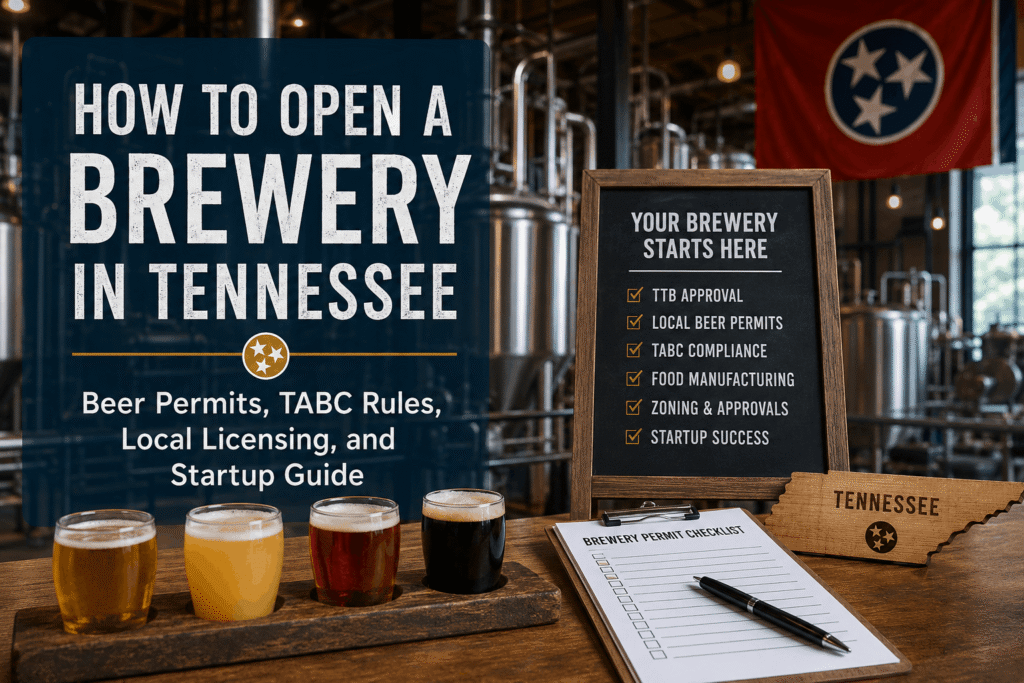
To open a brewery in Tennessee, you generally need federal TTB approval, local beer permits from the city or county where the brewery is located, applicable Tennessee Alcoholic Beverage Commission approvals for high-gravity beer or other alcohol activities, Tennessee Department of Agriculture food-manufacturing considerations, local zoning approval, building and fire approvals, and any health, wastewater, business, and tax registrations required for the specific location.
Tennessee is a strong target state for brewery growth because it combines population growth, tourism, restaurants, live entertainment, and destination hospitality. Nashville, Knoxville, Chattanooga, Memphis, Gatlinburg, Pigeon Forge, Franklin, Murfreesboro, Johnson City, and fast-growing suburban markets all have opportunities for local beer. But Tennessee is also a state where the beer regulatory structure can surprise first-time operators.
The most important thing to understand is that Tennessee’s alcohol rules split responsibilities across state and local authorities. The Tennessee Alcoholic Beverage Commission states that its jurisdiction covers alcoholic beverages with 8% or greater alcohol by weight or 10.1% alcohol by volume, and that it does not issue beer permits except for brewing high-gravity beer. For standard beer, applicants usually deal heavily with local beer boards.
That makes Tennessee a state where getting advice early can prevent expensive delays.
Why Tennessee is attractive for new brewery concepts
Tennessee remains one of the country’s strongest migration and hospitality states. It has destination tourism in Nashville and the Smoky Mountains, major entertainment districts, growing suburbs, and a business-friendly reputation. For brewery and brewpub entrepreneurs, that creates demand for local experiences, not just packaged beer.
In today’s market, that distinction matters. The craft beer industry is no longer in a simple “open and they will come” phase. The best opportunities are often connected to hospitality: restaurants, music venues, resorts, distilleries, wineries, golf clubs, food halls, and entertainment centers that want to add a branded house beer program.
EZBrew is well suited to that model because it helps operators add beer without building a traditional brewery from scratch. But the regulatory path still matters, especially in Tennessee.
Step 1: Understand Tennessee’s beer and alcohol structure
Tennessee’s regulatory structure can be confusing because not all beer is handled the same way. The TABC explains that it has jurisdiction over alcoholic beverages that are 8% or greater alcohol by weight or 10.1% or greater alcohol by volume. The TABC also states that it does not issue beer permits except for the brewing of high-gravity beer. For beer permits, establishments generally must contact their local beer board.
The University of Tennessee County Technical Assistance Service explains that a business engaged in the sale and manufacturing of beer must obtain a permit from the city or county where the business is located. It also notes that beer falls within the definition of food under Tennessee law, so manufacturing beer is subject to regulation by the Tennessee Department of Agriculture, and these establishments must obtain a food manufacturing license from the Department of Agriculture.
This means a Tennessee brewery project may involve:
- Federal TTB approval.
- Local city or county beer permit approval.
- TABC involvement for high-gravity beer or liquor-by-the-drink activity.
- Department of Agriculture food-manufacturing licensing.
- Local zoning, building, fire, utility, and health approvals.
That is a lot of moving parts.
Step 2: Choose the right Tennessee brewery model
Common Tennessee models include:
- A microbrewery or production brewery that manufactures beer.
- A taproom brewery that sells primarily on-site.
- A brewpub-style restaurant that manufactures and sells beer at or near the manufacturing location.
- A restaurant, entertainment venue, resort, winery, distillery, or golf club that wants house-brewed beer.
- A high-gravity beer concept that may involve TABC licensing.
Tennessee law includes an exception that allows a manufacturer meeting federal, state, and local licensing requirements to operate as a retailer at or contiguous to the manufacturer’s location for sales up to 25,000 barrels per year for on-premise or off-premise consumption. This is important for microbrewery and brewpub-style models, but it should not be treated casually. You still need to confirm the exact license and permit stack for your location and business plan.
Before moving forward, write down exactly what you intend to do:
- Brew beer only for on-site sale?
- Sell beer to-go?
- Distribute to other locations?
- Serve high-gravity beer?
- Operate a full restaurant?
- Sell liquor or wine in addition to beer?
- Host events or live music?
- Package beer for retail?
Each answer can affect the approvals you need.
Step 3: Apply for federal TTB approval
If you are brewing beer for sale, you generally need a TTB Brewer’s Notice. The TTB process is federal and separate from Tennessee local beer permits or TABC licensing. TTB approval typically requires entity documents, ownership information, premises control, brewery diagrams, equipment information, and operating details.
The TTB states that a brewer may not operate until the Brewer’s Notice is approved. That means you should start planning the federal application early and ensure your premises diagram matches the location you actually intend to use.
For an EZBrew-style project, the brewery diagram and process explanation should clearly describe the automated brewing equipment, fermentation area, ingredient inputs, cleaning process, storage, and beer handling. Do not assume regulators will understand how a small-footprint automated system differs from a traditional brewhouse.
Step 4: Work with the local beer board
Tennessee beer permits are often local. Cities and counties may have beer boards that meet on a schedule and require applications, background checks, location information, distance compliance, public meetings, and proof that the business satisfies local ordinances.
Local timing matters. For example, some Tennessee cities note that beer permit applicants must appear before a beer board and that the process can be lengthy, so applicants should apply well before opening or buying an existing business. If your opening date depends on beer sales, do not leave the local beer board until the end.
Before signing a lease, confirm:
- Whether beer manufacturing and retail beer sales are allowed at the address.
- Which beer board has jurisdiction.
- Meeting schedules and application deadlines.
- Distance requirements from schools, churches, parks, or residential areas.
- Food requirements, parking, occupancy, and fire-code requirements.
- Whether liquor-by-the-drink or high-gravity beer will require additional TABC licensing.
Step 5: Do not overlook the Department of Agriculture
Tennessee’s treatment of beer as a food-manufacturing activity can surprise operators. CTAS specifically notes that manufacturing beer is subject to regulation by the Tennessee Department of Agriculture and that these establishments must obtain a food manufacturing license.
For a traditional brewer, this may be familiar. For a restaurant or hospitality venue adding beer for the first time, it may not be. Plan for production sanitation, process descriptions, storage, cleaning, and facility expectations. Your brewing equipment plan should help make this easier, not harder.
EZBrew’s Brew-Ready Beer Kit model can help simplify the operating process compared with a traditional grain brewhouse, but the business still needs to respect the manufacturing and food-safety side of the operation.
Step 6: Plan utilities, wastewater, and layout
Tennessee hospitality markets can be competitive. The right space may be a restaurant, mixed-use development, entertainment district, historic building, strip center, resort property, or downtown venue. Not every location is automatically suited for brewing.
Before committing, evaluate:
- Floor drains and discharge points.
- Water supply and backflow prevention.
- Glycol/chiller location and heat rejection.
- Electrical needs.
- Space for tanks, ingredients, cleaning supplies, and kegging.
- Fire access and egress.
- Whether the local utility needs wastewater information.
- Whether the landlord approves brewing activity.
The advantage of a smaller automated system is that it may reduce the buildout burden compared with a conventional brewery. But it still must be explained clearly to the landlord, municipality, and inspectors.
The danger of going alone on Tennessee regulatory
Tennessee is one of the states where “I can figure it out myself” can become costly. The federal, local, state, and agriculture layers do not all operate through one agency. If you call one office and receive one answer, that answer may not cover the full project.
Common Tennessee mistakes include:
- Assuming TABC issues all beer permits.
- Missing the local beer board process.
- Forgetting that high-gravity beer is treated differently.
- Failing to obtain food-manufacturing approval.
- Signing a lease before confirming distance and zoning requirements.
- Missing beer board meeting schedules.
- Buying equipment before confirming drains, utilities, and approved premises areas.
- Assuming a restaurant license is enough to manufacture beer.
EZBrew helps reduce these risks by helping operators think through the full startup path: equipment, brewing workflow, ingredient supply, training, remote support, and regulatory assistance. EZBrew is not a law firm, but it gives customers a practical framework instead of forcing them to learn everything by trial and error.
Tennessee brewery startup checklist
- Define the business model: brewery, brewpub, restaurant brewery, or hospitality add-on.
- Determine whether the beer will fall into standard beer or high-gravity beer categories.
- Confirm the local beer board, application deadlines, and hearing schedule.
- Verify zoning and distance requirements before signing the lease.
- Prepare the TTB Brewer’s Notice and premises diagram.
- Review TABC requirements if high-gravity beer, liquor-by-the-drink, or other alcohol activities are involved.
- Plan for Tennessee Department of Agriculture food-manufacturing requirements.
- Coordinate building, fire, health, utility, and wastewater approvals.
- Select equipment that fits the approved premises and labor model.
- Build a realistic timeline from licensing to installation to first beer served.
FAQ: Opening a brewery in Tennessee
Does Tennessee require a local beer permit?
Yes, in many cases. A business engaged in the sale and manufacturing of beer must obtain a permit from the city or county where the business is located.
Does TABC issue beer permits in Tennessee?
The Tennessee Alcoholic Beverage Commission states that it does not issue beer permits except for the brewing of high-gravity beer. For beer permits, establishments should contact the local beer board.
Do Tennessee breweries need a food manufacturing license?
Yes. CTAS notes that beer manufacturing is subject to regulation by the Tennessee Department of Agriculture and that these establishments must obtain a food manufacturing license.
Is Tennessee a good state for a brewpub?
Yes. Tennessee has strong hospitality, tourism, and population-growth trends. The opportunity is especially attractive for restaurants and venues that want house beer as part of a larger guest experience.
Can EZBrew help open a brewery in Tennessee?
Yes. EZBrew helps with automated brewing equipment, Brew-Ready Beer Kits, training, remote support, regulatory assistance, and startup planning for restaurants and hospitality operators. Contact the team for a demo today.