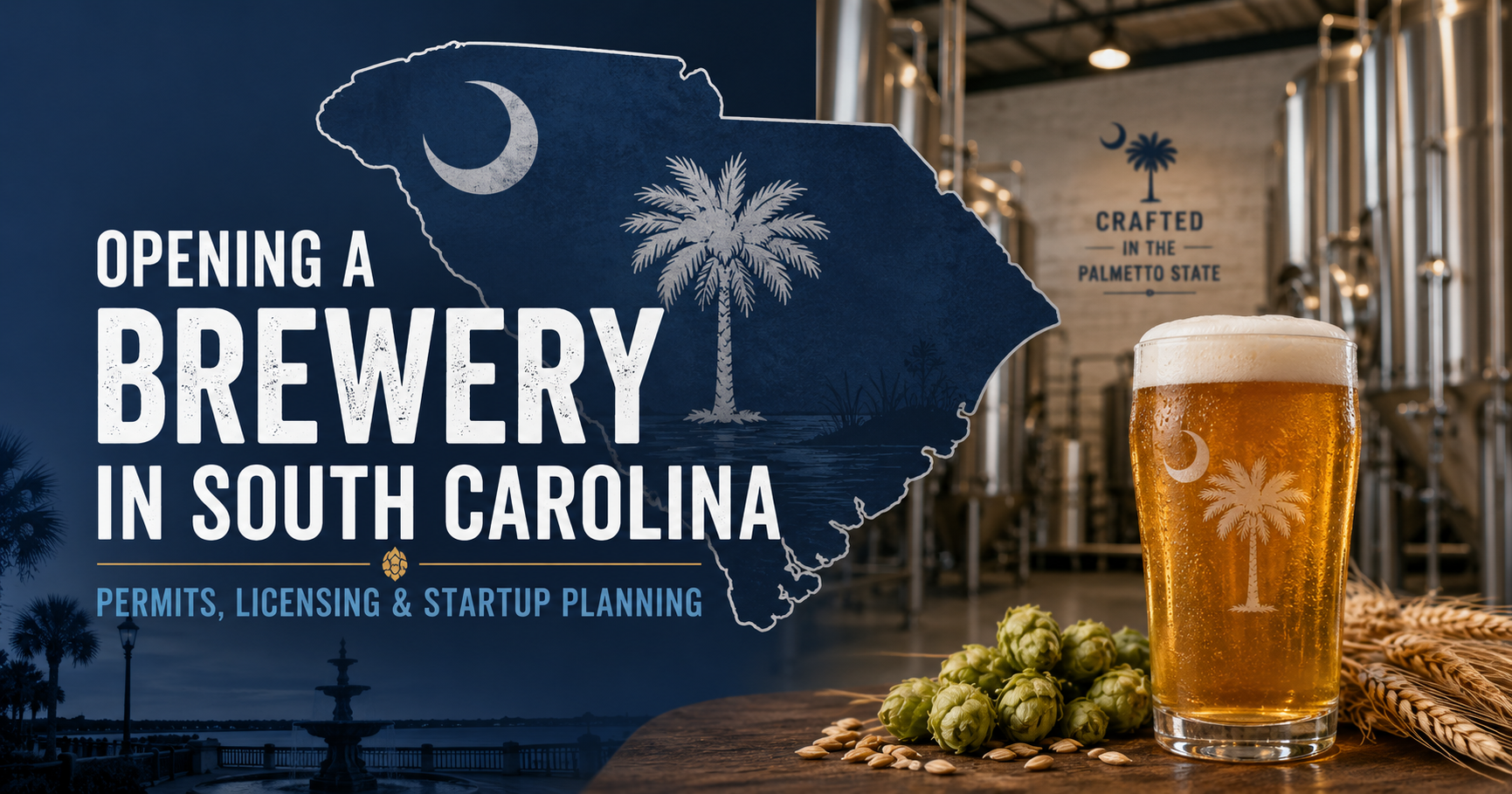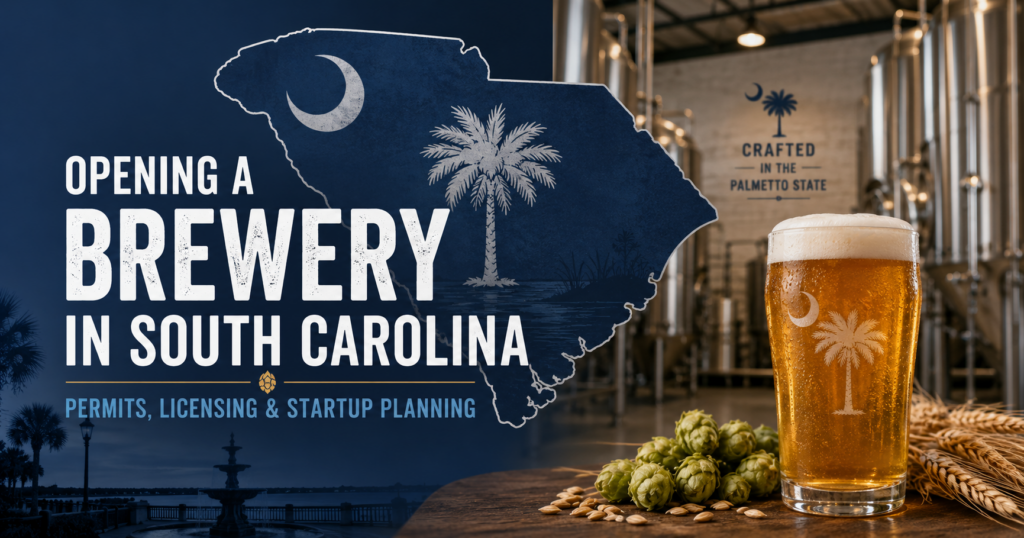
To open a brewery in South Carolina, you generally need federal approval from the TTB, the correct South Carolina Department of Revenue Alcohol Beverage Licensing permit, local zoning approval, building and fire approvals, and any health, food-service, wastewater, and business licenses required by your city or county. South Carolina has distinct paths for a Brewery Permit and a Brewpub Permit, and choosing the wrong path can affect how much beer you can produce, where you can sell it, whether you can distribute, and how your business is structured.
South Carolina is one of the most attractive states for new brewery and brewpub concepts because it combines fast population growth with strong tourism and hospitality markets. Charleston, Greenville, Columbia, Myrtle Beach, Hilton Head, Spartanburg, Rock Hill, and many fast-growing suburban markets are all candidates for restaurant-based brewing, golf-club brewing, entertainment-district brewing, and small-footprint automated brewpubs.
The key is not simply asking, “Can we open a brewery?” The better question is, “Which South Carolina license path matches our business model?” A production brewery, a brewpub, a restaurant, a resort, and a venue that wants house beer may all require different planning.
Why South Carolina is a high-opportunity brewery state
South Carolina has become one of the leading domestic migration states in the country. The U.S. Census Bureau reported that South Carolina had the highest percentage population growth of any state between July 2024 and July 2025, growing 1.5%, driven heavily by domestic migration. For brewery operators, that means more new residents, more new neighborhoods, more hospitality development, and more demand for local experiences.
The opportunity is especially interesting for EZBrew because future brewery openings may not look like the craft beer boom of the 2010s. The market is more disciplined now. Operators are less likely to succeed by opening a large production brewery just because craft beer is popular. The stronger opportunity is a focused hospitality model: a restaurant, entertainment venue, winery, distillery, resort, golf club, or small taproom that uses beer as a profit center and customer-experience feature.
In South Carolina, that business model can work well, but only if the license, location, and operating plan are aligned from the start.
Step 1: Understand the difference between a South Carolina Brewery Permit and Brewpub Permit
South Carolina’s Department of Revenue Alcohol Beverage Licensing division lists separate permit categories for breweries and brewpubs.
The South Carolina Brewery Permit authorizes the manufacturing or brewing of beers, ales, porters, or similar malt beverages. SCDOR states that this permit also authorizes the sale and on-premises consumption of beverages brewed at the licensed location if the sales are made in conjunction with a brewery tour. SCDOR also makes clear that the Brewery Permit does not authorize the sale or consumption of wine or liquor, the sale or consumption of beer not produced at the licensed location, curbside sales, drive-through sales, or delivery of beer to purchasers.
The South Carolina Brewpub Permit is different. SCDOR states that the Brewpub Permit authorizes the sale of beer and wine for on-premises consumption and to go, and also authorizes the license holder to manufacture or brew up to 2,000 barrels per year of beer, ale, porter, or similar malt beverage to be sold on the licensed premises. SCDOR also states that a Brewpub Permit does not authorize sales to wholesalers for distribution or distribution and sale to retail locations.
That distinction is critical. A restaurant-style concept that wants to sell its own beer primarily on-site may be a brewpub candidate. A production brewery that wants broader wholesale distribution may need a different license strategy. If you get this wrong, your business may be limited in ways you did not expect.
Step 2: Budget for South Carolina permit fees and timing
As of the current SCDOR guidance, the Brewery Permit has a non-refundable filing fee of $300 and a license fee of $400 due every two years with license renewal. The Brewpub Permit has a non-refundable filing fee of $300 and a license fee of $2,200 due every two years with license renewal. SCDOR notes that a prorated amount of the license fee is due after approval.
The fee amount is usually not the biggest cost. The bigger cost is delay. South Carolina applications can require a valid South Carolina Retail License, completed application forms, ownership and premises information, public notice through a newspaper advertisement, functioning sanitary restrooms, and a lease, deed, or other document showing the right to use and control the licensed premises. These details need to be ready early.
A business should not wait until construction is nearly complete to understand which permit it needs. The permitting strategy should be part of the site-selection and lease-negotiation process.
Step 3: Get federal TTB approval
Any brewery that produces beer for sale must also qualify federally with the TTB. The TTB Brewer’s Notice is separate from South Carolina licensing. The federal process requires detailed information about the business entity, ownership, premises, lease or property control, brewery diagram, equipment, operations, and responsible parties.
TTB approval should be built into the project timeline. You should not assume that a South Carolina permit or local business license allows commercial brewing without federal qualification. TTB approval, state approval, local zoning, and building inspections are separate pieces of the opening puzzle.
This is one of the reasons it is risky to go alone. Brewery applicants often assume the government agencies are all reviewing the same issue. They are not. TTB cares about federal brewery qualification, premises control, records, tax, and operations. SCDOR cares about state alcohol licensing. The city or county cares about zoning, building, fire, and local business requirements. The utility may care about wastewater. The health department may care about food service. You need all of them to line up.
Step 4: Confirm zoning, food service, and local approvals
South Carolina is a local-control state in many practical ways. The same brewery model that works in Charleston may not be treated the same way in Greenville, Columbia, Myrtle Beach, Beaufort, or Spartanburg. Before signing a lease, confirm whether your proposed use is allowed.
Questions to ask early include:
- Is manufacturing allowed at the address?
- Is a brewpub, restaurant brewery, taproom, or production brewery allowed in the zoning district?
- Does the location need a special exception, zoning interpretation, or conditional approval?
- Does the lease allow alcohol manufacturing and tank installation?
- Are patios, outdoor consumption, live music, events, and to-go sales allowed?
- Are there parking, restroom, occupancy, or fire-code issues?
- Does the local utility require information on discharge, pH, cleaning chemicals, or solids?
If food is central to the concept, also plan for food-service permitting. A brewpub is often a hospitality business first and a manufacturing business second. That means the food, alcohol, building, and utility paths must be coordinated.
Step 5: Prepare for server training and ongoing compliance
SCDOR states that beginning January 1, 2026, all alcohol servers and managers who serve alcohol for on-premises consumption must complete an approved server training program. Licensees and servers must maintain a digital or physical copy of each server’s certificate for the duration of employment.
This matters because opening a brewery is not only about getting the license. Ongoing compliance affects staffing, training, recordkeeping, renewals, taxes, service practices, and how the business handles events, to-go sales, and alcohol service.
For an owner-operator, the compliance burden can become distracting. For a restaurant group or hospitality venue, it can be even more complicated because the brewing component adds a manufacturing layer to an already-regulated business.
Step 6: Avoid overbuilding the brewery
South Carolina’s growth makes it tempting to build big. But the current craft beer environment rewards discipline. The Brewers Association has reported that brewery closures have recently outpaced openings nationally, which means new operators need a stronger business case than “craft beer is popular.”
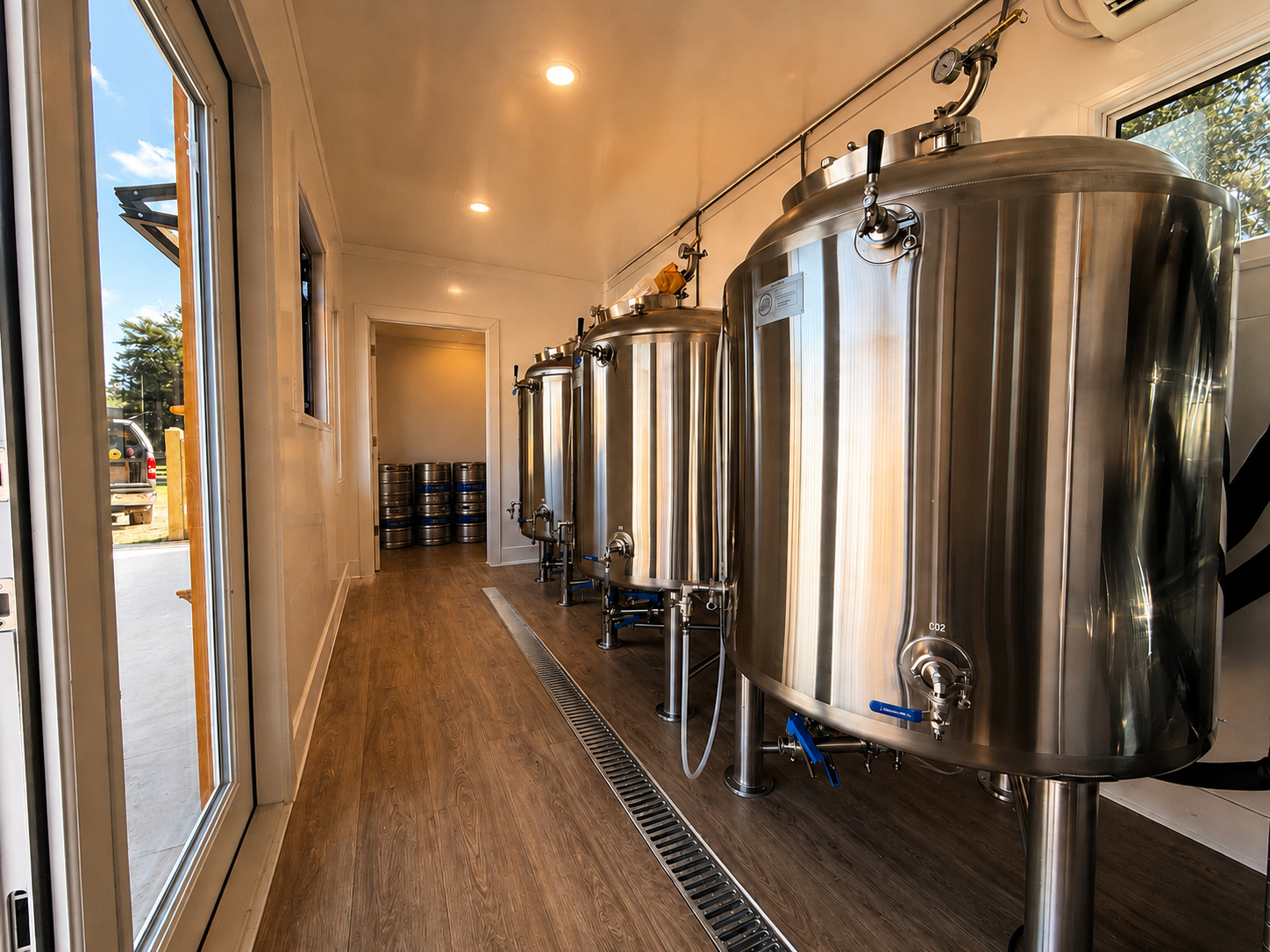
For many South Carolina projects, the goal should be to add profitable, local, branded beer without overcomplicating the business. A traditional brewery buildout can require extensive capital, experienced labor, grain handling, hot-side brewing equipment, floor drains, glycol systems, large utilities, and a production schedule that may not match customer demand.
EZBrew offers a different path. EZBrew’s automated brewing system, Brew-Ready Beer Kits, training, remote support, and regulatory assistance are designed to help hospitality operators produce beer without becoming a traditional brewery. This can be especially attractive for restaurants, resorts, golf clubs, wineries, and entertainment venues that want the customer experience and margin of house beer while keeping the operation manageable.
The danger of going alone on South Carolina regulatory
The biggest danger is not that opening a brewery is impossible. The danger is spending money in the wrong order. A South Carolina brewery project can run into problems when the owner signs a lease before confirming the license path, buys equipment before understanding local utility concerns, assumes a brewpub permit allows distribution, or assumes a brewery permit works like a restaurant license.
Common South Carolina mistakes include:
- Confusing the Brewery Permit and Brewpub Permit.
- Missing the 2,000-barrel annual production limit for brewpubs.
- Assuming brewpub beer can be distributed to other retail locations.
- Forgetting the Retail License requirement.
- Missing public notice or premises-control documentation.
- Underestimating server training and renewal obligations.
- Failing to prepare a clear wastewater and cleaning-process explanation.
- Designing the brewery before verifying the approved premises area.
EZBrew helps customers think through these issues before they become delays. While EZBrew is not a law firm, its team understands the practical startup sequence for small-footprint breweries and can help coordinate the equipment, regulatory, and operational plan.
South Carolina brewery startup checklist
- Choose the business model: brewery, brewpub, restaurant brewery, taproom, or hospitality add-on.
- Decide whether the Brewery Permit or Brewpub Permit better fits your sales model.
- Confirm local zoning and alcohol eligibility before signing the lease.
- Prepare the TTB Brewer’s Notice and brewery premises diagram.
- Obtain or prepare the required South Carolina Retail License if applicable.
- Gather lease, deed, or premises-control documents.
- Prepare public notice and application documents for SCDOR.
- Coordinate building, fire, health, and utility approvals.
- Train alcohol servers and managers as required.
- Select equipment that matches your space, labor, volume, and revenue goals.
FAQ: Opening a brewery in South Carolina
What is the difference between a brewery and a brewpub in South Carolina?
A South Carolina Brewery Permit is focused on manufacturing beer and allows on-premises consumption of beer brewed at the location in conjunction with a brewery tour. A South Carolina Brewpub Permit is designed for an on-premise beer-and-wine hospitality model and allows brewing up to 2,000 barrels per year for sale on the licensed premises.
Can a South Carolina brewpub distribute its beer?
SCDOR states that the Brewpub Permit does not authorize sales to wholesalers for distribution or distribution and sale to retail locations. If distribution is part of your plan, review the license path carefully before moving forward.
Do I need federal approval to open a brewery in South Carolina?
Yes. A business producing beer for sale generally needs TTB approval through a Brewer’s Notice before commercial brewing.
Is South Carolina a good state for a new brewery?
Yes, especially for hospitality-focused models. South Carolina has strong population growth, strong tourism, and growing restaurant markets. The opportunity is strongest when the brewery is built around a clear customer experience and profit model.
Can EZBrew help in South Carolina?
Yes. EZBrew can help operators understand equipment options, brewing workflow, regulatory steps, training, and startup planning for a smaller, more automated brewery model.